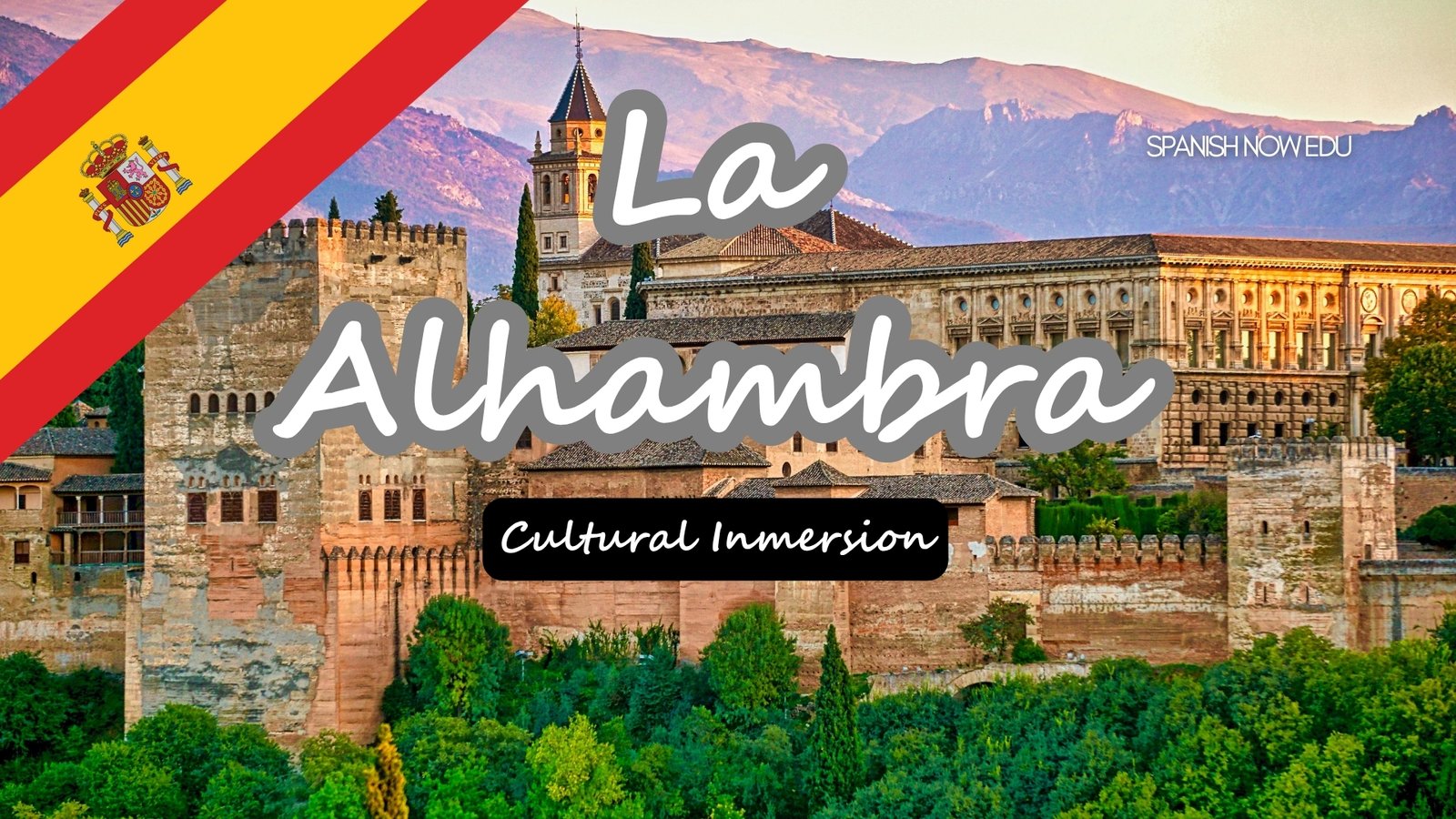
The Alhambra is one of Spain’s most iconic monuments. Located in Granada, it offers a unique combination of history, art and Spanish language learning opportunities. For English-speakers learning Spanish, exploring the Alhambra gives you not only vocabulary but cultural immersion. Today in @spanisnowedu, you will learn about what the Alhambra is, why it matters, and how you can use it to improve your Spanish. Let’s begin.
What is the Alhambra?
The Alhambra is a palace and fortress complex perched above the city of Granada, in Andalusia.
Wikipedia. Its name comes from the Arabic al-Ḥamrāʾ, meaning “the red fortress”. It was begun by the Nasrid dynasty in the 13th century and expanded through the 14th century under Yusuf I and Muhammad V. Today it is a UNESCO World Heritage Site.
History and Significance
Building began around 1238 when Muhammad I Ibn al-Ahmar founded the Nasrid Emirate. The complex became both royal residence and military citadel. Between 1238 and 1358 the major work took place. After 1492, when the Catholic Monarchs conquered Granada, the Alhambra passed into Christian hands and in 1526 Emperor Charles V commissioned a Renaissance palace within the site.
Because of this layered history, the Alhambra represents the convergence of Muslim, Christian and Jewish cultural influences in Spain. It is more than architecture: it is a cultural lesson and rich vocabulary source for Spanish learners.
Architecture, Art and Environment
The Alhambra stands high on the Sabika hill overlooking Granada’s Albaicín district.
Inside, the Nasrid palaces are decorated with intricate stucco work, mosaics, inscriptions in Arabic and water-features. For example, in the Patio de los Leones you will find twelve marble lions and a fountain that symbolizes sultan’s power. Water was central: channels and reflecting pools brought together nature and architecture. Walking among the arches and gardens you naturally absorb Spanish vocabulary connected to space, architecture, nature and history.
Legends, Myths and Cultural Stories
The Alhambra is full of stories. The “Tower of the Infantas” is tied to a legend about three sisters locked in the tower because of forbidden love. These legends offer rich vocabulary: sultan, princess, tower, tears, legend. Use them to build your Spanish vocabulary while immersing yourself in culture.
Learn Spanish through the Alhambra (Video Section)
To make your learning interactive, we have created a video that takes you through the Alhambra in Spanish (A2-B1 level). You will hear key vocabulary, short sentences, and explanations designed for English-speakers learning Spanish.
Watch the video, pause when you see a new word, repeat aloud, and try to imagine the place in Spanish. This method blends listening, speaking and visual learning.
Exercise – Listening Comprehension “La Alhambra”
Now it’s time to test your understanding of what you watched. Complete the following questions based on the video you have just watched.
Test your Spanish reading and listening comprehension about La Alhambra, one of Spain’s most iconic monuments. Answer these 10 questions based on the video and article. Practice vocabulary, grammar, and cultural understanding in context.
Why This Lesson Matters
Using the Alhambra as a context for language learning makes Spanish come alive. You are not just memorizing words: you are hearing, seeing and understanding culture, history and architecture. This strengthens memory, vocabulary retention and listening skills. For example, talking about courtyards, fountains, palaces and legends adds depth beyond basic vocabulary lists.
The Alhambra is more than a castle; it is a rich ecosystem of language and culture. By studying it, you practice Spanish, you dive into history and you connect with the world. Watch the video, complete the exercise, revisit the vocabulary, and enjoy your Spanish journey.
Continue exploring more Spanish through culture at our website. take a look from our article about The Amazon River:
Until next time – ¡Hasta luego!