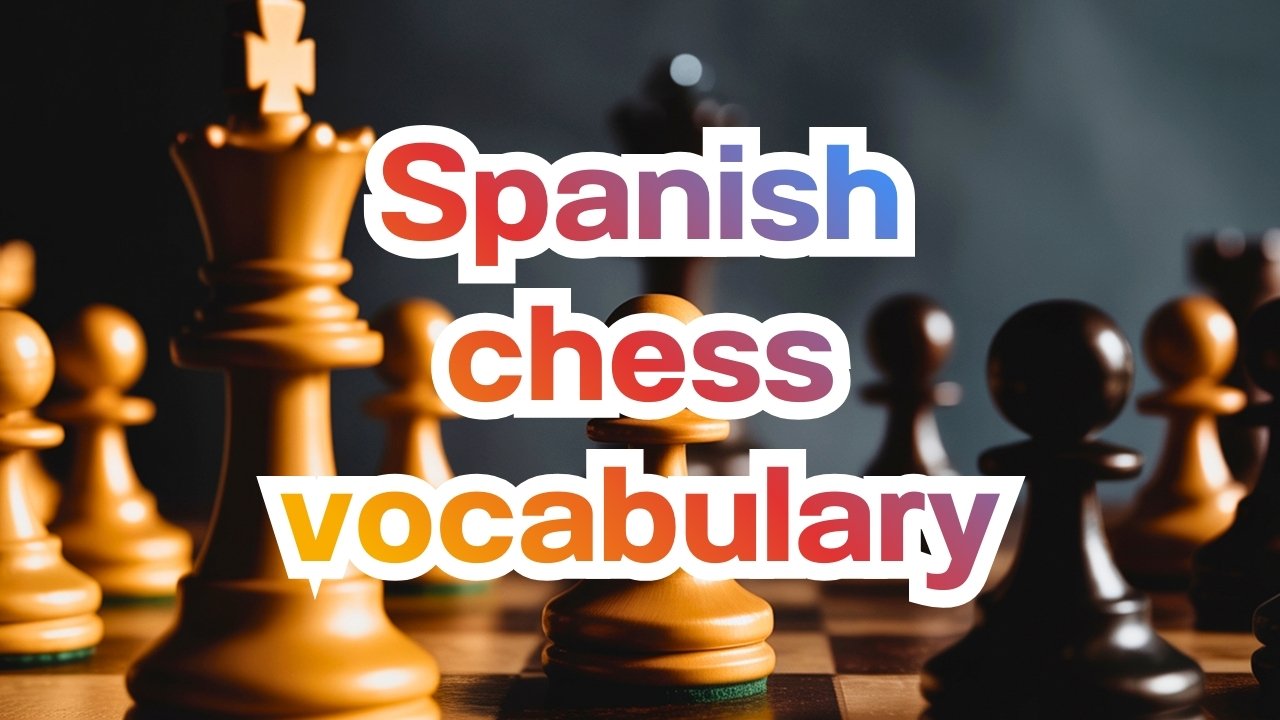
Spanish Chess Vocabulary: Essential Terms to Play and Understand the Game.
Chess is a universal game, but the language used to talk about it changes from country to country. If you are learning Spanish and enjoy chess, this lesson is a perfect opportunity to combine strategy and language learning. Understanding chess vocabulary in Spanish will help you follow games, read instructions, talk with other players, and enjoy chess content in Spanish-speaking countries.
This article is designed for beginner and intermediate Spanish learners, especially English speakers. The language is clear, practical, and focused on real usage.
In this @spanishnowedu article, you will find:
- the full chess vocabulary explained in Spanish and English
- example sentences to see each word in context
- a fill-in-the-blanks exercise to reinforce understanding
- a crossword-style vocabulary exercise
- a complete list of essential chess terms
You can also watch the video lesson below to hear the pronunciation and practice listening before completing the activities. Repetition is key. Each time you listen and read, your comprehension and confidence improve.
Watch the Video: Spanish Chess Vocabulary
In the video, you will hear the most important chess terms pronounced clearly. Listen first without reading. Then listen again while following the article and examples. This will help train your ear and reinforce pronunciation.

Essential Chess Vocabulary in Spanish (With English Meaning)
Below is a detailed explanation of the most important chess terms in Spanish. Each term includes its English translation and a simple example sentence. And in every sentence we have included (when applicable) the article commonly used with the word in Spanish.
Vocabulary List and Explanations
El ajedrez (chess): El ajedrez es un juego de estrategia. Chess is a strategy game.
El tablero (board): El tablero de ajedrez tiene sesenta y cuatro casillas. The chess board has sixty-four squares.
La casilla (square): Esta casilla es blanca. This square is white.
Las piezas de ajedrez (chess pieces) Las piezas de ajedrez están colocadas en el tablero. Chess pieces are settled on the board.
El rey (king): El rey es la pieza más importante. The king is the most important piece.
La reina o la dama (queen): La reina se mueve en todas las direcciones. The queen moves in all directions.
La torre (rook). La torre se mueve en línea recta.The rook moves in a straight line.
El alfil (bishop) : El alfil se mueve en diagonal. The bishop moves diagonally.
El caballo (knight): El caballo salta sobre otras piezas. The knight jumps over other pieces.
El peón (pawn): El peón avanza una casilla. The pawn moves forward one square.
Las piezas blancas (white chessmen) Las blancas empiezan el juego. White chessmen starts the game.
Las piezas negras (black chessmen): Luego las piezas negras responden. Afterwards, black chessmen respond.
Chess moves and strategies in Spanish
Jaque (check): Cuando el rey está en peligro, está en jaque. When the king is in danger, he is in check.
El jaque mate (checkmate): Cuando no se puede hacer nada para salvar al rey, es jaque mate. When nothing is possible to save the king, is checkmate.
Pieza clavada o clavada (Pinned): Pieza clavada es cuando una pieza no puede moverse, porque al hacerlo expondría a ataque a una pieza de mayor valor (como el rey o la dama). Pinned is when a chess piece cannot move , because of so, it exposes another chess piece more valuable as the king or the queen.
Los movimientos de ajedrez (chess moves). Existen tres movimientos especiales de ajedrez: enroque, promoción del peón y captura al paso. There are three special chess moves: castling, pawn promotion, and en passant capture.
Enrocarse (Castling). Enrorcarse es cuando el rey y la torre se mueven al mismo tiempo. Castling is when the king and the rook move at the same time.
Enroque corto (Kingside castling). Enroque corto es un tipo de enroque donde la torre se sitúa en la casilla del alfil. Kingside castling is a king of castling where the rook is situated at the bishop square.
Enroque largo (Queenside castling) El enroque largo es una jugada de ajedrez donde la torre se sitúa en la casilla de la dama. Queenside castling is a chess play in which the rook places itself at the queen square.
Another Chess words
El turno (turn) Ahora es el turno del otro jugador. Now it is another chess player’s turn.
El empate o tablas (draw or stalemate). La partida termina en empate. La partida termina en tablas. The game ends in a draw.
La partida (chess match / chess game): La partida de ajedrez fue muy larga. The chess game was very long.
La apertura (opening). La apertura es importante. The opening is important.
El final (endgame). El final requiere precisión. The endgame requires precision.
La estrategia (strategy). La estrategia define la partida. Strategy defines the game.
La táctica (tactic). Esta táctica es efectiva. This tactic is effective.
Verbs for Chess in Spanish
Ganar (to win). Quiero ganar esta partida. I want to win this chess game.
Perder (to lose). No me gusta perder. I do not like to lose.
Rendirse (to surrender): El jugador decide rendirse. The player decides to surrender.
Pensar (to think). Debes pensar antes de mover. You must think before moving.
Capturar (to capture). La reina captura el peón. The queen captures the pawn.
Defender (to defend). Debes defender tu rey. You must defend your king.
Atacar (to attack) El jugador decide atacar. The player decides to attack.
Exercises
Fill in the Blanks
Instructions: Complete each sentence with the correct Spanish chess word. Choose the word that best fits the context.
Exercise 2: Chess Vocabulary Crossword (Crosswoard)
Instructions. Read each clue and write the correct Spanish chess word.
Why Learning Chess Vocabulary in Spanish Helps Your Fluency
Learning topic-based Spanish vocabulary like chess helps your brain organize language more efficiently. Instead of memorizing isolated words, you connect terms through meaning and context. This improves recall, listening comprehension, and speaking confidence.
Chess vocabulary is especially useful because it includes action verbs, nouns, and abstract concepts like strategy and decision-making. These skills transfer easily to real conversations in Spanish.
Chess is more than a game. It is a language of strategy, logic, and communication. By learning chess vocabulary in Spanish, you expand your language skills while enjoying something you already love.
We recommend watching the video, reading the vocabulary explanations, and completing the exercises more than once. Repetition builds fluency.
Thank you for practicing Spanish with us. Keep learning, keep playing, and continue exploring Spanish through meaningful topics.
You could also be interested at: