Learning Spanish pronunciation one step at a time is one of the most effective ways to build confidence.
Today in @spanishnowedu, were going to focus on the pronunciation of the letter F in Spanish.
We work with syllables formed by one consonant and one vowel.
This method helps learners recognize sounds clearly and reproduce them naturally.
This article is part of our Spanish Pronunciation with Syllables series.
Each lesson focuses on one letter and its syllables.
You listen, repeat, and practice with real words and simple sentences.
This lesson is designed for English speakers learning Spanish at beginner or early intermediate level.
How the Letter F Is Pronounced in Spanish
The Spanish letter F sounds almost the same as the English F. It is pronounced by placing the upper teeth lightly on the lower lip. Air passes through, creating a soft friction sound.
The pronunciation of F does not change depending on the vowel.This makes it easier to learn than some other Spanish sounds.
Spanish Syllables with One Consonant and One Vowel
In Spanish, syllables are very regular.
Most basic syllables are formed by one consonant + one vowel. These are the ones we are going to be focsing on here.
In this lesson, we practice:
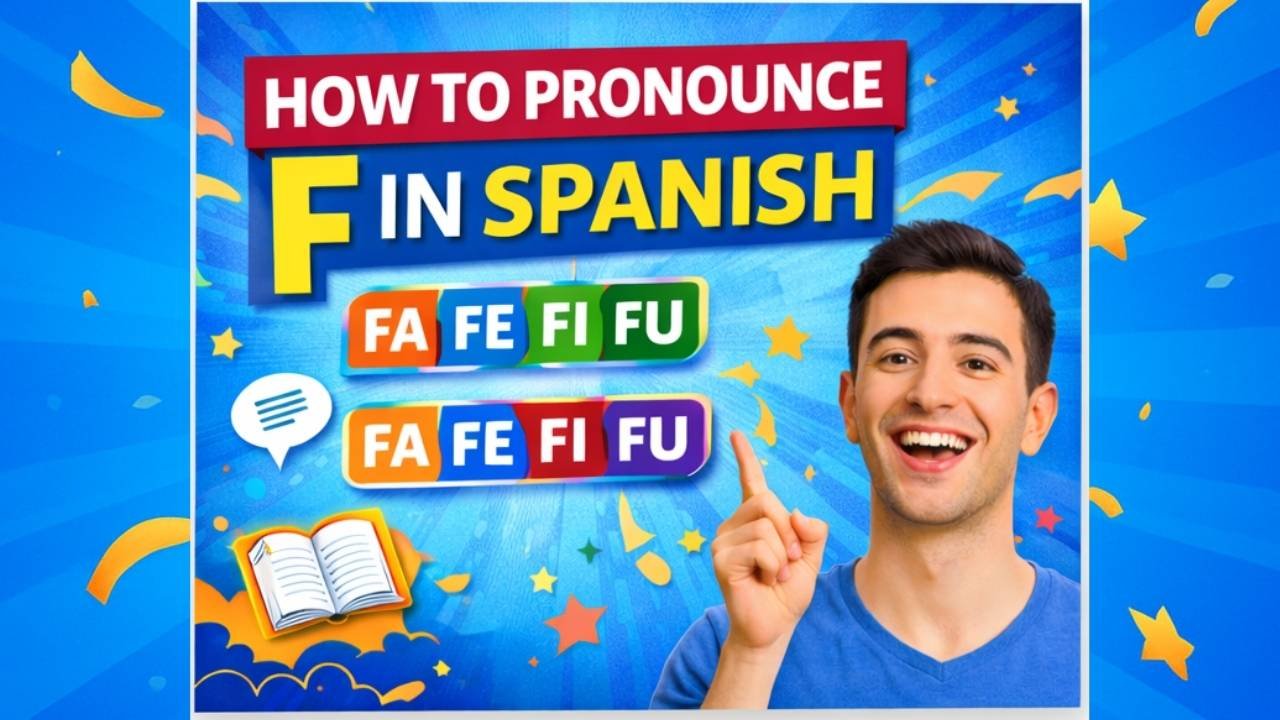
- FA
- FE
- FI
- FO
- FU
Each syllable keeps the same F sound. Only the vowel changes. This system helps learners read and pronounce new words easily.
Examples of Spanish words beginning with these F sounds include:
- familia (family)
- feliz (happy)
- figura (figure)
- foca (seal)
- fumar (to smoke)
FA Syllable
The syllable FA in Spanish is pronounced like “fah.”
The F sound is made by placing your upper teeth gently on your lower lip and letting air flow out softly, just like the English f in “family” or “fine.”
The vowel A is open and clear, similar to the “a” in “father.” Your mouth opens wide and your tongue stays low.
When you combine these two sounds, you get FA, a clean and easy sound to pronounce.
Examples with FA:
- familia (family)
- fabuloso (fabulous – masculine)
- fácil (easy)
FE Syllable
The syllable FE in Spanish is pronounced like “feh.” The F sound is made by placing your upper teeth gently on your lower lip and letting air flow out softly, just like the English f in “fine” or “family.” The vowel E is short and crisp, similar to the “e” in “bet,” but usually a bit clearer and more precise.
When you combine these two sounds, you get FE, a clean and steady syllable.
Examples with FE:
- feliz (happy.)
- fecha (date)
- fé (faith)
FI Syllable
The syllable FI in Spanish is pronounced like “fee.”
The F sound is made by placing your upper teeth gently on your lower lip and letting air flow out softly, just like the English f in “fine.”
The vowel I is long and clear, similar to the “ee” sound in “see,” but usually a bit shorter and more precise.
When you combine these two sounds, you get FI, a clean and easy syllable to pronounce.
Examples with FI:
- figura (figure)
- final (end)
- fibra (fiber)
FO Syllable
In Spanish, the syllable FO is pronounced like “foh.” The F sound is made by placing your upper teeth gently on your lower lip and letting air flow out softly, just like the English f in “fine.” The vowel O is round and strong. Your lips form a rounded shape, similar to the “o” in “note,” but usually shorter and more direct.
When you combine these two sounds, you get FO, a firm and clear syllable.
Word examples with FO:
- foca (seal)
- foto (photo)
- fogata (campfire)
FU Syllable
The syllable FU in Spanish is pronounced like “foo.”
The F sound is made by placing your upper teeth gently on your lower lip and letting air flow out softly, just like the English f in “fine.”
The vowel U is deep and closed. Your lips form a small, rounded shape, similar to the “oo” in “food,” but usually shorter and more controlled.
When you combine these two sounds, you get FU, a focused and steady syllable.
Some word examples with FU include:
- fumar (to smoke.)
- futuro (future)
- fumigar (to fumigate)
Why Practicing Syllables Improves Pronunciation
As we move further into our section on Spanish syllable pronunciation, you already have a strong base. You’ve practiced several syllables and learned how consistent Spanish sounds can be. At this stage, syllable work becomes even more useful because it helps you recognize patterns faster, read more smoothly, and speak with a rhythm that feels natural.
- Pronouncing new words accurately. Knowing how each syllable sounds makes new words easier to break down. Spanish spelling is very consistent, so you can pronounce unfamiliar words by dividing them into simple sound units. This reduces hesitation and helps you say new vocabulary correctly on the first try.
- Reading Spanish with greater confidence. Syllable practice helps you stop reading letter by letter. Instead, you read in small sound blocks, which increases speed and fluency. As you improve, you recognize common patterns more quickly, making reading easier and comprehension stronger.
- Speaking with a more natural rhythm. Spanish uses even, steady syllables. English rhythm is different, so practicing syllables helps you avoid transferring English stress patterns into Spanish. This gives your speech a smoother, more natural flow and makes your pronunciation clearer.
Video Lesson: Spanish Letter F
In the video lesson, you will hear:
- Each syllable repeated three times
- One word for each syllable
- One simple sentence per word
The format is listen and repeat. You can pause the video and practice aloud.

Exercises
Exercise 1: Crossword F Spanish pronuntiation
Instructions: Complete the crossword using Spanish words beginning with syllables FA, FE, FI, FO, or FU.
Exercise 2: Fill in the Blanks
Instructions: Complete the paragraph using the correct word.
Exercise 3: Multiple Choice
Instructions: Choose the correct word to complete each sentence.
The Spanish letter F is friendly and easy to learn. Its sound is clear and consistent.
The syllables FA, FE, FI, FO, and FU follow simple rules.
With repetition and practice, your pronunciation will improve quickly. Keep practicing with our videos, articles, and exercises.
Don’t forget to watch the video above and repeat along with the syllables.
You can also explore our other pronunciation lessons as:
B and vowel pronunciation in Spanish
The C and vowel Sound in Spanish
Spanish D Pronunciation | Learn DA DE DI DO DU with Syllables