Stop confusing SER and ESTAR. Use SER for permanent traits (identity, origin, profession) and ESTAR for temporary states (location, emotions, health). Here is the complete breakdown. Tener in Spanish: Complete Conjugation Guide with Easy Examples
The verb tener is one of the first and most useful verbs every Spanish learner should master. It appears in everyday conversations, helps you express possession, age, physical conditions, emotions, and is used in many common Spanish expressions that native speakers say every day.
In this @spanishnowedu lesson, you’ll learn how to conjugate tener using the most important Spanish verb tenses. Instead of overwhelming you with every possible tense, we’ll focus on the ones you’ll encounter most often in conversations, books, videos, and daily life.
Our goal is simple: help you build a strong foundation that will make learning more advanced Spanish grammar much easier later. You’ll also find a pronunciation video, practical examples, and interactive exercises to reinforce what you’ve learned. Comencemos.
What Does Tener Mean in Spanish? Definition and Common Uses
Spanish verb tener usually means “to have.” It is an irregular verb and one of the most frequently used verbs in the language. For example, when saying: Yo tengo un coche, You’re meaning I have a car.
However, tener is much more than a verb for possession. Spanish speakers use it to express many ideas that English often expresses with the verb to be. One of the reasons tener is such an important Spanish verb is that it is used in many everyday expressions. Unlike English, where these ideas are often expressed with the verb to be, Spanish usually uses tener (“to have”).
Learning these expressions will help you sound more natural and understand native speakers in everyday conversations. Let’s see some examples:
- Tener hambre: To be hungry: Tengo hambre porque no he desayunado. I am hungry because I haven’t had breakfast.
- Tener sed: To be thirsty. Tengo mucha sed después de correr. I am very thirsty after running.
- Tener frío: To be cold. Ella tiene frío porque hace mucho viento. She is cold because it is very windy.
- Tener calor: To be hot. Nosotros tenemos calor en verano. We are hot in the summer.
- Tener sueño: To be sleepy. Tengo sueño porque dormí poco anoche. I am sleepy because I didn’t sleep much last night.
- Tener miedo: To be afraid. Los niños tienen miedo de la oscuridad. Children are afraid of the dark.
- Tener razón: To be right. Tú tienes razón.
- Tener prisa: To be in a hurry. Tenemos prisa porque el tren sale en cinco minutos. We are in a hurry because the train leaves in five minutes.
- Tengo 28 años. I’m 28 years old.
These expressions are extremely common in spoken Spanish. Memorizing them will make your conversations sound more natural and help you understand everyday Spanish.
Tener Conjugation: The Most Important Spanish Verb Tenses
Spanish has many verb tenses, and as your level improves you’ll gradually learn how and when to use each one.
In this lesson, we’ll focus on the six tenses that are used most frequently in everyday Spanish:
- Present
- Preterite (Simple Past)
- Imperfect
- Present Perfect
- Past Perfect
- Future
Mastering these tenses will give you an excellent foundation for reading, listening, speaking, and writing Spanish. Once you’re comfortable with them, learning more advanced tenses will become much easier.
Tener in the Present Tense: Conjugation and Examples
The present tense describes actions and situations happening now or things that are generally true.
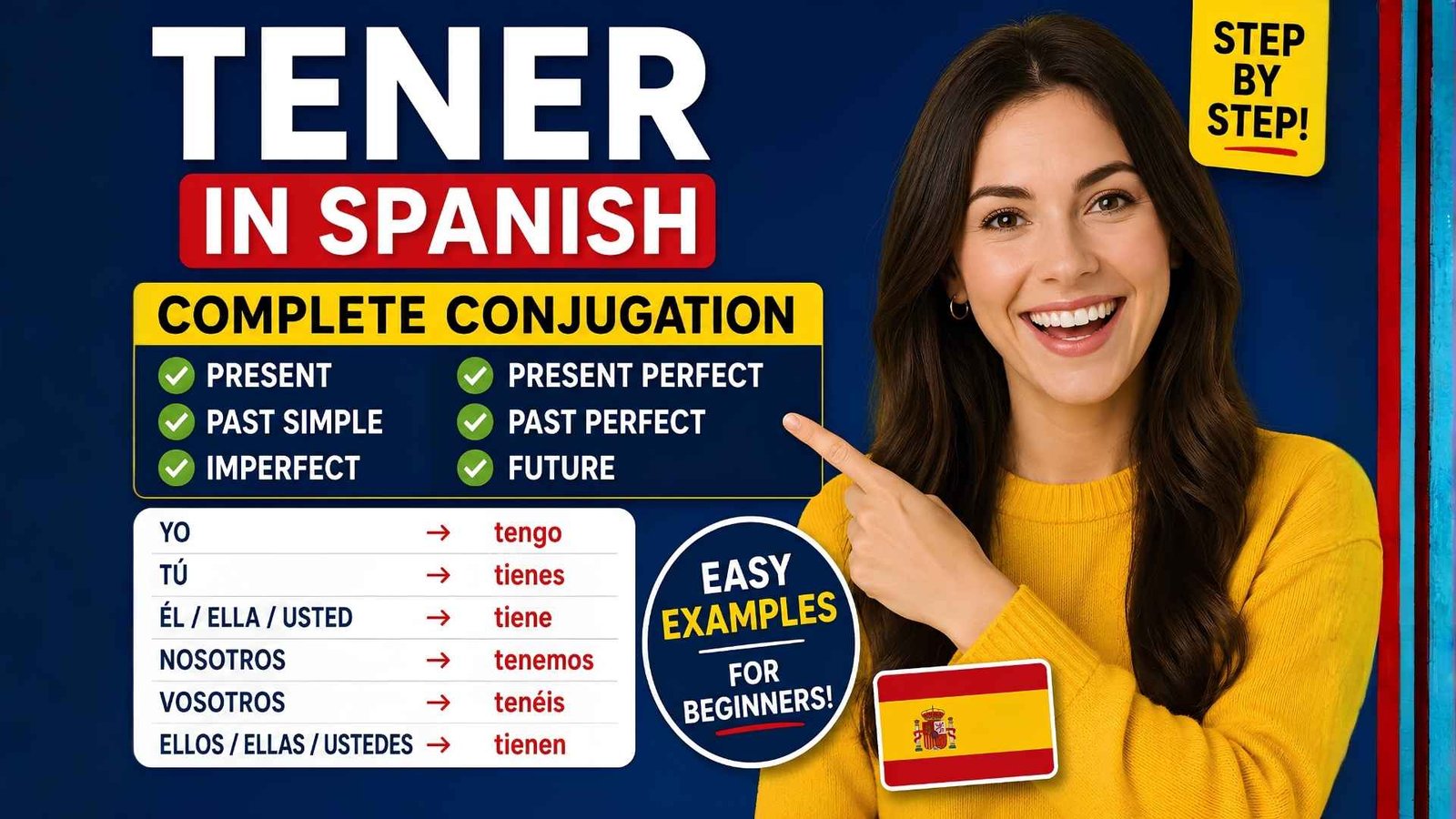
| Pronoun | Conjugation | Example |
|---|---|---|
| Yo | tengo | Yo tengo una casa. |
| Tú | tienes | Tú tienes un perro. |
| Él | tiene | Él tiene un coche. |
| Ella | tiene | Ella tiene dos hermanos. |
| Usted | tiene | Usted tiene razón. |
| Nosotros | tenemos | Nosotros tenemos tiempo. |
| Vosotros | tenéis | Vosotros tenéis suerte. |
| Ellos | tienen | Ellos tienen hambre. |
| Ellas | tienen | Ellas tienen una reunión. |
| Ustedes | tienen | Ustedes tienen una casa. |
Tener in the Preterite Tense (Simple Past): Conjugation and Examples
The preterite describes completed actions in the past.
| Pronoun | Conjugation | Example |
|---|---|---|
| Yo | tuve | Yo tuve un problema. |
| Tú | tuviste | Tú tuviste suerte. |
| Él | tuvo | Él tuvo un accidente. |
| Ella | tuvo | Ella tuvo una idea. |
| Usted | tuvo | Usted tuvo razón. |
| Nosotros | tuvimos | Nosotros tuvimos tiempo. |
| Vosotros | tuvisteis | Vosotros tuvisteis éxito. |
| Ellos | tuvieron | Ellos tuvieron hambre. |
| Ellas | tuvieron | Ellas tuvieron una reunión. |
| Ustedes | tuvieron | Ustedes tuvieron una casa. |
Tener in the Imperfect Tense: Conjugation and Examples
The imperfect describes habitual actions or ongoing situations in the past.
| Pronoun | Conjugation | Example |
|---|---|---|
| Yo | tenía | Yo tenía un perro. |
| Tú | tenías | Tú tenías mucho trabajo. |
| Él | tenía | Él tenía una bicicleta. |
| Ella | tenía | Ella tenía una amiga. |
| Usted | tenía | Usted tenía razón. |
| Nosotros | teníamos | Nosotros teníamos tiempo. |
| Vosotros | teníais | Vosotros teníais suerte. |
| Ellos | tenían | Ellos tenían hambre. |
| Ellas | tenían | Ellas tenían una reunión. |
| Ustedes | tenían | Ustedes tenían una casa. |
Tener in the Present Perfect: Conjugation and Examples
The present perfect connects the past with the present.
| Pronoun | Conjugation | Example |
|---|---|---|
| Yo | he tenido | Yo he tenido suerte. |
| Tú | has tenido | Tú has tenido éxito. |
| Él | ha tenido | Él ha tenido un problema. |
| Ella | ha tenido | Ella ha tenido una reunión. |
| Usted | ha tenido | Usted ha tenido razón. |
| Nosotros | hemos tenido | Nosotros hemos tenido tiempo. |
| Vosotros | habéis tenido | Vosotros habéis tenido suerte. |
| Ellos | han tenido | Ellos han tenido hambre. |
| Ellas | han tenido | Ellas han tenido una oportunidad. |
| Ustedes | han tenido | Ustedes han tenido una casa. |
Tener in the Past Perfect: Conjugation and Examples
The past perfect describes an action that happened before another action in the past.
| Pronoun | Conjugation | Example |
|---|---|---|
| Yo | había tenido | Yo había tenido suerte. |
| Tú | habías tenido | Tú habías tenido problemas. |
| Él | había tenido | Él había tenido un accidente. |
| Ella | había tenido | Ella había tenido una idea. |
| Usted | había tenido | Usted había tenido razón. |
| Nosotros | habíamos tenido | Nosotros habíamos tenido tiempo. |
| Vosotros | habíais tenido | Vosotros habíais tenido suerte. |
| Ellos | habían tenido | Ellos habían tenido hambre. |
| Ellas | habían tenido | Ellas habían tenido éxito. |
| Ustedes | habían tenido | Ustedes habían tenido una casa. |
Tener in the Future Tense: Conjugation and Examples
The future tense describes actions that will happen.
| Pronoun | Conjugation | Example |
|---|---|---|
| Yo | tendré | Yo tendré tiempo. |
| Tú | tendrás | Tú tendrás una oportunidad. |
| Él | tendrá | Él tendrá un coche. |
| Ella | tendrá | Ella tendrá éxito. |
| Usted | tendrá | Usted tendrá razón. |
| Nosotros | tendremos | Nosotros tendremos vacaciones. |
| Vosotros | tendréis | Vosotros tendréis suerte. |
| Ellos | tendrán | Ellos tendrán hambre. |
| Ellas | tendrán | Ellas tendrán una reunión. |
| Ustedes | tendrán | Ustedes tendrán una casa. |
Watch the Video: Learn Tener in Spanish Step by Step
Watching and listening is one of the best ways to remember Spanish verb conjugations. In the video below, you’ll hear each conjugation pronounced clearly while seeing practical examples for every subject pronoun and verb tense.
As you watch, pause the video after each example and repeat the sentences aloud. Speaking along with the lesson helps improve both your pronunciation and your confidence using tener in real conversations.

Practice Exercises: Master Tener in Spanish
The following exercises will help you reinforce the conjugations you’ve just learned. Read each question carefully before answering, and don’t worry if you make mistakes. Repetition is one of the most effective ways to master Spanish verbs.
Exercise 1: Choose the Correct Tener Conjugation
Select the sentence that correctly translates the English sentence.
Exercise 2: Complete the Sentences with Tener
Complete the paragraph using the correct form of tener.
Learning tener verb is one of the best investments you can make as a Spanish learner. Because it appears in so many everyday conversations and expressions, mastering its most common conjugations will immediately improve your ability to understand and communicate in Spanish.
Remember that Spanish has additional verb tenses beyond those covered in this lesson. However, the present, preterite, imperfect, present perfect, past perfect, and future tenses form the foundation that most learners need before moving on to more advanced grammar.
Continue building your Spanish skills by exploring our complete series of Spanish verb guides. You can also learn the conjugations and uses of Ser in Spanish, Estar in Spanish, and Ir in Spanish, which are three of the most important verbs you’ll use every day.
The more you practice these essential verbs, the more natural Spanish will become.