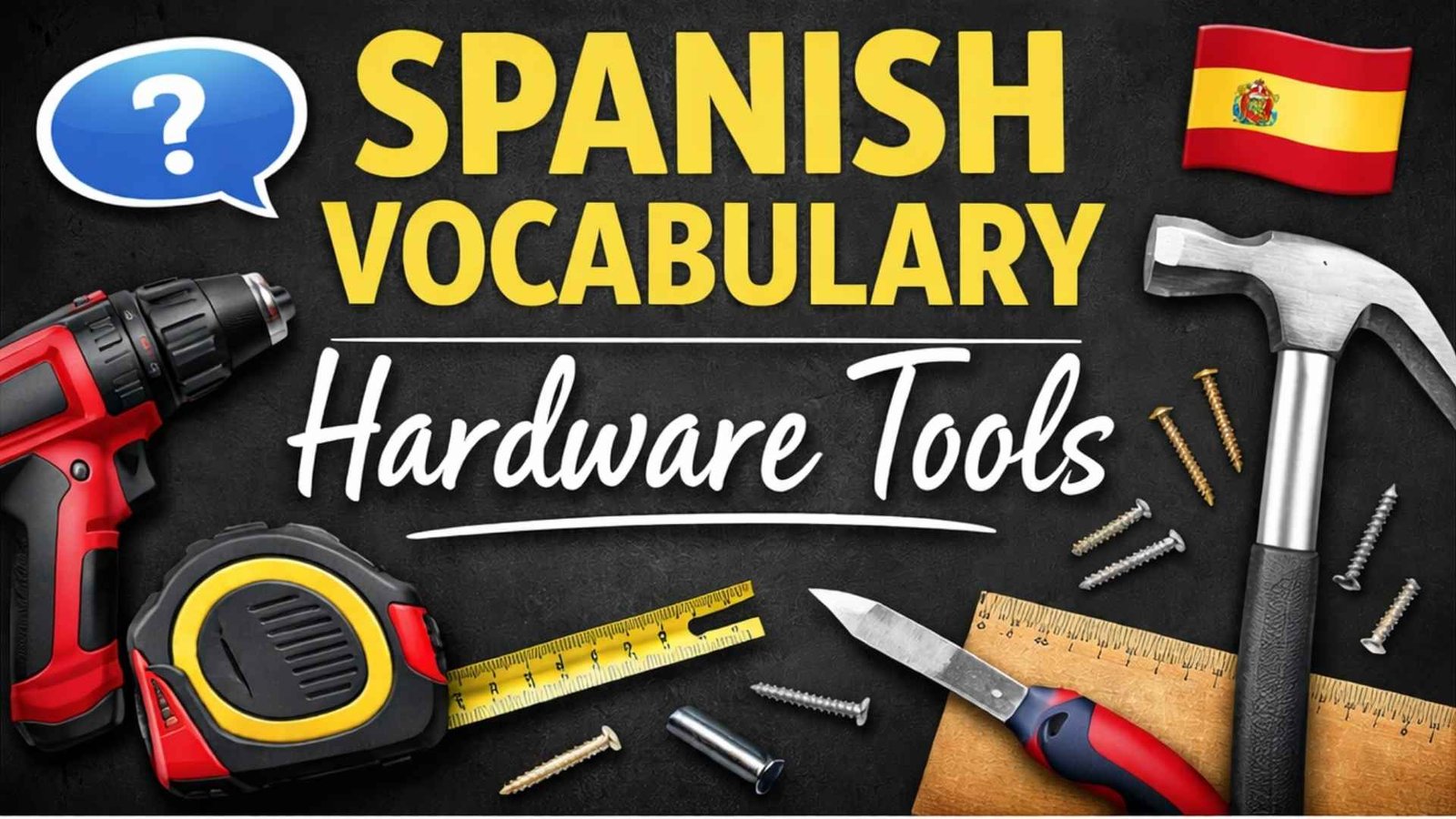
Learning Spanish vocabulary related to hardware tools and construction materials is extremely useful for real-life situations. Whether you are fixing something at home, traveling, or working in construction, this vocabulary helps you communicate clearly and confidently.
In this @spanishnowedu lesson, you will learn:
- Basic hardware tools in Spanish
- Fasteners and fixing elements
- Building materials
- Common verbs used in a hardware store
- Useful phrases for real conversations
This content is part of our special grammar & vocabulary section, where you learn Spanish step by step using real-life topics.
BASIC TOOLS (HERRAMIENTAS BÁSICAS)
Below you can see common tools with their English meaning and an easy sentence:
- Martillo (hammer). Necesito un martillo. (I need a hammer).
- Destornillador (screwdriver). El destornillador está en la caja. (The screwdriver is in the box).
- Taladro (drill). Uso el taladro para hacer un agujero. (I use the drill to make a hole).
- Llave (wrench). La llave es para apretar el perno. (The wrench is to tighten the bolt).
- Alicates (pliers) .Los alicates cortan el cable. (The pliers cut the cable).
- Madera (wood). La madera es un material natural muy usado en casas.(Wood is a natural material plenty used at home).
- Cemento (cement). El cemento se usa para construir paredes y pisos.(Cement is used for wall and floor building).
- Ladrillo (brick). La casa está hecha de ladrillo rojo.(The house is made from red bricks).
- Arena (sand). Mezclamos arena con cemento y agua. (We mixed sand with cement and water).
- Yeso (plaster). El yeso se usa para cubrir las paredes. (Plaster is used to cover walls).
- Pintura (paint). Necesito pintura blanca para mi habitación. (I need white paint for my room).
- Barniz (varnish) El barniz protege la madera. (The varnish protects the wood).
- Brocha (paintbrush). Pinto la pared con una brocha. (I paint the wall with a paintbrush).
- Rodillo (paint roller). Uso un rodillo para pintar más rápido. (I use a paint roller for painting quicker).
- Tubo (tube). El agua pasa por el tubo.(Water passes through the tube).
- Tubería (pipe). La tubería del baño está rota. (The bathroom’s pipe is broken).
- Cable (cable). El cable conecta la electricidad. (The cable connects the electricity).
FASTENERS AND FIXING (TORNILLOS Y FIJACIÓN)
These words are essential when fixing or building something. There you have some useful vocabulary for that:
- Tornillo (screw). Estoy buscando tornillos pequeños. (I am looking for small screws).
- Clavo (nail). El clavo está en la pared. (The nail is in the wall).
- Tuerca (nut). La tuerca va con el perno. (The nut goes with the bolt).
- Arandela (washer). La arandela protege el tornillo. (The washer protects the screw).
- Pegamento (glue). Uso pegamento para pegar madera. (I use glue to glue wood).
BUILDING MATERIALS (MATERIALES DE CONSTRUCCIÓN)
These materials are common in construction and home repair. Here are some words and sentences you can use at the hardware store:
- Madera (wood). La mesa es de madera. (The table is made of wood).
- Cemento (cement). El cemento está seco. (The cement is dry).
- Ladrillo (brick). El muro tiene muchos ladrillos. (The wall has many bricks).
- Yeso (plaster). El yeso cubre la pared. (The plaster covers the wall).
- Pintura (paint). La pintura es blanca. (The paint is white).
Common Verbs in a Hardware Store
Verbs are essential to communicate actions when you are in a hardware store. These common Spanish verbs will help you ask for materials, explain what you are doing, and understand basic instructions. Each verb is shown with a simple sentence in Spanish and its meaning in English.
- Medir (to measure). Necesito medir la pared antes de comprar la pintura. (I need to measure the wall before buying the paint).
- Cortar (to cut). Voy a cortar la madera con el serrucho. (I am going to cut the wood with the hand saw).
- Clavar (to nail). Él va a clavar el clavo en la pared. (He is going to nail the nail into the wall).
- Atornillar (to screw). Debes atornillar el tornillo con el destornillador. (You must screw the screw with the screwdriver).
- Taladrar (to drill). Vamos a taladrar la pared para poner el cuadro. (We are going to drill the wall to hang the picture).
- Pegar (to glue). Voy a pegar la pieza con pegamento. (I am going to glue the piece with glue).
- Pintar (to paint). Ella quiere pintar la habitación de blanco. (She wants to paint the room white).
- Arreglar (to fix). Estoy arreglando una silla rota. (I am fixing a broken chair).
- Construir (to build). Ellos van a construir una mesa de madera. (They are going to build a wooden table).
Reading Comprehension Exercise: Hardware Store Verbs in Spanish
Instructions: Read the following text carefully. It describes a simple situation using common Spanish verbs related to tools and home repairs.
First, read the text without translating every word. Try to understand the general idea.
Then, read it again more slowly and pay attention to the verbs and vocabulary.
After reading, answer the multiple-choice questions below. Choose the correct answer for each question based on the information in the text.
“Estoy arreglando algo en casa. Para ello, necesito un martillo, tornillos y madera. Voy a construir una repisa pequeña. ¿que necesito hacer?
Bueno…. primero debo medir la pared y luego usar el taladro para hacer un agujero. Después atornillo los tornillos con el destornillador. Finalmente, quiero pintar la madera de blanco.
Solamente estoy usando herramientas básicas de ferretería”.
Fill in the Blanks: Hardware Store Vocabulary in Context (Spanish)
Instructions: Read the paragraph carefully. It describes a common situation using Spanish vocabulary from a hardware store.
Below the text, you will see a list of words. Complete each blank with the correct word. Use each word only once. Focus on meaning and context.
Words to use
martillo – tornillos – madera – medir – pintura – taladro – brocha – pared
Crossword: Hardware Store Vocabulary in Spanish
Instructions: Complete the crossword using the clues in English.
All the answers are Spanish words related to tools, materials, or actions in a hardware store.
Learning Spanish becomes easier and more effective when you study vocabulary that you can use in real life. Hardware store vocabulary is especially useful because it combines objects, actions, and practical situations that learners often face at home or while traveling.
In this lesson, you learned common Spanish words for tools, materials, and actions used in a hardware store. You also practiced these words through simple examples and interactive exercises. This approach helps you move from memorizing vocabulary to understanding how Spanish works in context.
Remember that pronunciation, repetition, and context are key. Try to say the words out loud, repeat the example sentences, and imagine yourself using this vocabulary in a real situation. The more you practice, the more confident you will feel.