This lesson was created for beginner Spanish learners who want to improve vocabulary, listening, and daily conversation skills naturally.
Learning Spanish becomes much easier when you connect the language to real actions in your everyday life. One of the best ways for beginners to practice vocabulary and grammar is by matching daily routine steps with Spanish phrases.
In this guide, you will learn:
- common Spanish daily routine vocabulary,
- reflexive verbs,
- common mistakes English speakers make,
- example routines for different people,
- and a fun Spanish crossword activity.
This article focuses more on vocabulary, grammar patterns, reflexive verbs, and practical sentence building. Together, both lessons help you develop a more complete understanding of how native speakers talk about everyday life in Spanish.
Even if you are a complete beginner, this method can help you start thinking in Spanish naturally.
Why Learning Spanish Through Daily Routines Works So Well for Beginners
Daily routines are one of the best ways to learn Spanish naturally. You already know these actions in English, so your brain can easily connect them to new Spanish words and phrases.
Every day you wake up, eat breakfast, work, study, relax, and go to sleep. Because these actions repeat constantly, the vocabulary becomes easier to remember. Instead of memorizing random words, you learn language you can actually use in real life.
Daily routine vocabulary is also perfect for beginners because the sentences are usually short and simple:
- “Me levanto.”
- “Desayuno.”
- “Voy al trabajo.”
- “Me acuesto.”
These small phrases help you build confidence quickly.
If you already read our article “Daily Routine in Spanish: A Day in Erica’s Life (Listening Exercise)”, this lesson will help you even more. Erica’s story allows you to hear natural Spanish in context and improve your listening skills. This article focuses more on understanding the vocabulary, grammar, reflexive verbs, and sentence patterns behind those routines.
Together, both lessons help you move from simply recognizing Spanish to actually using it in your own daily life.
Master Everyday Spanish Faster with Daily Routine Phrases
Before learning the vocabulary in detail, take a look at the infographic below. It introduces some of the most common Spanish daily routine phrases beginners use in real conversations every day.
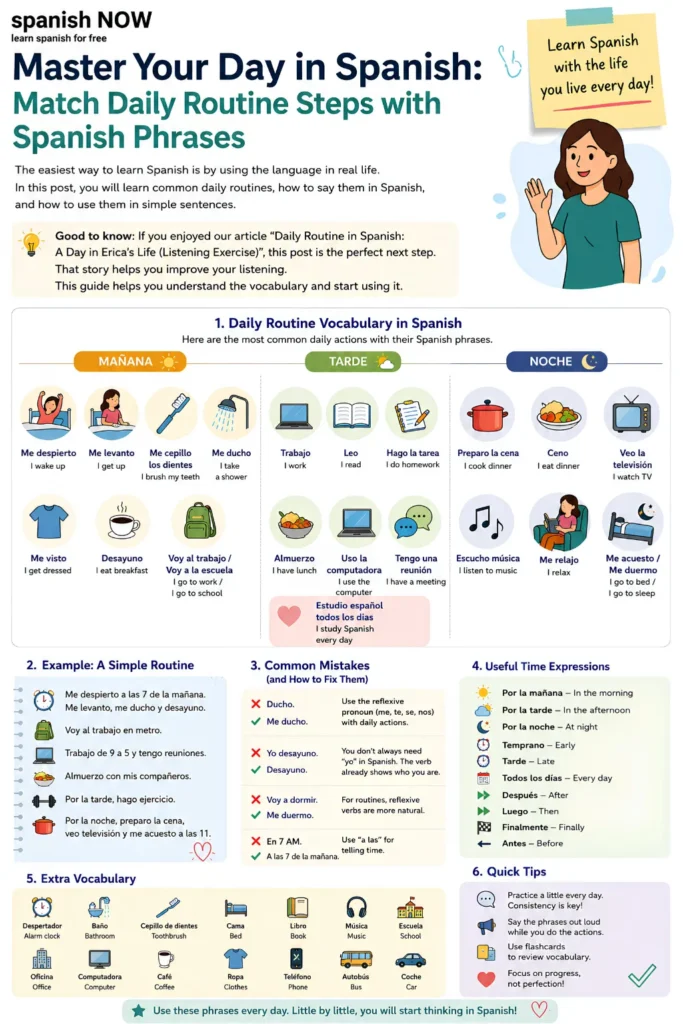
Try reading each Spanish phrase aloud and identifying the reflexive verbs used in the routine expressions. You will see many of these structures again throughout the lesson and exercises below.
One of the easiest ways to start speaking Spanish is by learning the phrases you can use every single day. Daily routines help beginners remember vocabulary naturally because the actions already exist in your normal life.
In the next table, you will learn some of the most common daily routine phrases in Spanish. These are expressions native speakers use constantly when talking about their mornings, work, studies, and evening activities.
Do not try to memorize everything immediately. Focus on recognizing the patterns first. You will notice that many routines use reflexive verbs like:
- me levanto
- me ducho
- me acuesto
These structures are extremely common in beginner Spanish conversations.
The table below will help you connect:
- the action in English,
- the Spanish phrase,
- and a simple real-life example in Spanish.
This makes the vocabulary easier to understand and remember.
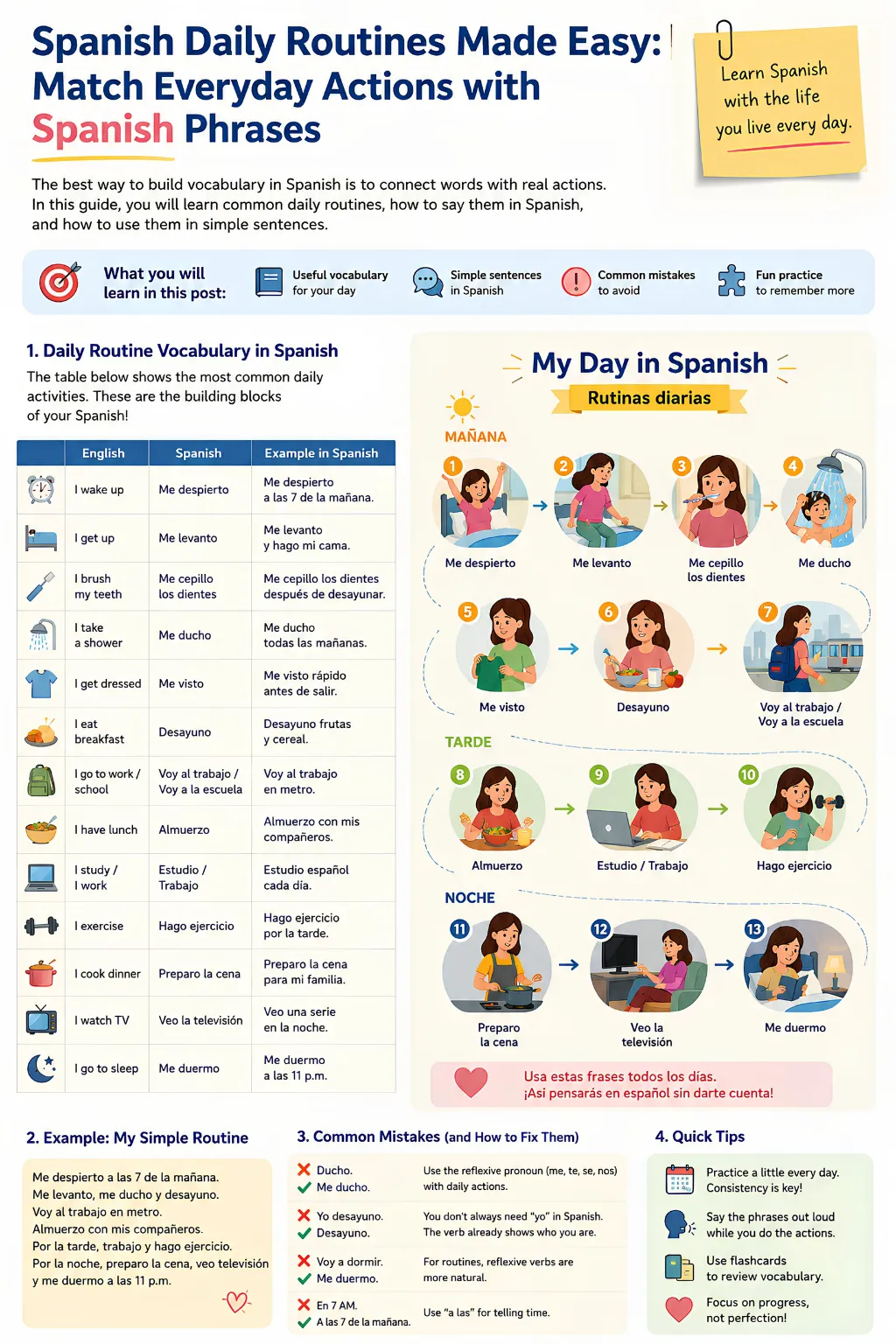
Essential Daily Routine Vocabulary in Spanish
The infographic below summarizes essential Spanish daily routine vocabulary with simple visual associations to help beginners remember the phrases more naturally.
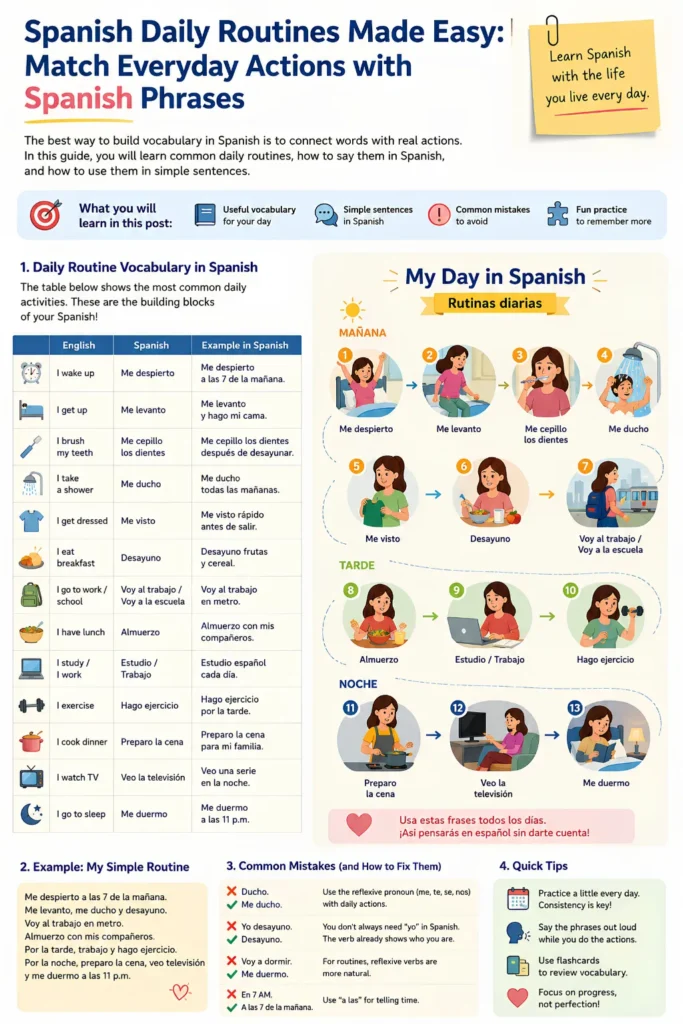
Visual learning can make Spanish vocabulary easier to remember. Review these daily routine phrases several times and try connecting them with your own everyday habits.
| English Action | Spanish Phrase | Simple Example in Spanish |
|---|---|---|
| I wake up | Me despierto | Me despierto a las 7 de la mañana. |
| I get up | Me levanto | Me levanto temprano todos los días. |
| I brush my teeth | Me cepillo los dientes | Me cepillo los dientes después del desayuno. |
| I take a shower | Me ducho | Me ducho por la mañana. |
| I get dressed | Me visto | Me visto rápidamente para ir al trabajo. |
| I eat breakfast | Desayuno | Desayuno café y tostadas. |
| I go to work | Voy al trabajo | Voy al trabajo en autobús. |
| I go to school | Voy a la escuela | Voy a la escuela a las 8. |
| I study Spanish | Estudio español | Estudio español todos los días. |
| I work | Trabajo | Trabajo desde casa. |
| I have lunch | Almuerzo | Almuerzo con mis compañeros. |
| I do homework | Hago la tarea | Hago la tarea por la tarde. |
| I exercise | Hago ejercicio | Hago ejercicio después del trabajo. |
| I cook dinner | Preparo la cena | Preparo la cena para mi familia. |
| I watch TV | Veo la televisión | Veo la televisión por la noche. |
| I relax | Me relajo | Me relajo escuchando música. |
| I go to bed | Me acuesto | Me acuesto a las 11. |
| I go to sleep | Me duermo | Me duermo muy rápido. |
Morning Routine Vocabulary in Spanish
| English | Spanish |
|---|---|
| I wake up | Me despierto |
| I get up | Me levanto |
| I make the bed | Hago la cama |
| I brush my teeth | Me cepillo los dientes |
| I wash my face | Me lavo la cara |
| I take a shower | Me ducho |
| I get dressed | Me visto |
| I comb my hair | Me peino |
| I eat breakfast | Desayuno |
| I drink coffee | Tomo café |
Work and Study Vocabulary in Spanish
| English | Spanish |
|---|---|
| I go to work | Voy al trabajo |
| I go to school | Voy a la escuela |
| I study | Estudio |
| I work | Trabajo |
| I have lunch | Almuerzo |
| I use the computer | Uso la computadora |
| I have a meeting | Tengo una reunión |
| I do homework | Hago la tarea |
| I read | Leo |
| I write | Escribo |
Evening Routine Vocabulary in Spanish
| English | Spanish |
|---|---|
| I cook dinner | Preparo la cena |
| I eat dinner | Ceno |
| I watch TV | Veo la televisión |
| I relax | Me relajo |
| I listen to music | Escucho música |
| I go to sleep | Me duermo |
| I go to bed | Me acuesto |
Reflexive Verbs in Spanish: Why “Me” Is So Important
One of the biggest differences between English and Spanish daily routines is the use of reflexive verbs. This is one of the first grammar topics beginners notice when learning how to talk about everyday activities.
In English, people usually say:
- “I wake up”
- “I take a shower” or
- “I get dressed”
But in Spanish, these actions normally need a reflexive pronoun.
That is why native speakers say:
- Me despierto
- Me ducho
- Me visto
and not simply:
- Despierto
- Ducho
- Visto
The small word before the verb is extremely important.
What Does “Me” Mean in Spanish?
In this lesson, we are mostly talking about routines for “I” (yo). That is why you constantly see the word: me. Examples: Me levanto o me acuesto
But Spanish changes the reflexive pronoun depending on the person.
So if you talk about:
Tú, Él, Ella, Ellos, Nosotros, Nosotras, Vosotros o Vosotras, the reflexive word changes too.
Spanish Reflexive Pronouns Explained
| Subject | Reflexive Pronoun | Example |
|---|---|---|
| Yo (I) | me | Me ducho |
| Tú (You) | te | Te levantas |
| Él (He) | se | Se ducha |
| Ella (She) | se | Se despierta |
| Nosotros (We) | nos | Nos vestimos |
| Vosotros (You plural) | os | Os bañáis |
| Ellos (They) | se | Se visten |
| Ellas (They) | se | Se despiertan |
Here are some very common examples beginners should recognize:
Examples of Reflexive Verbs with Different Pronouns
Here are some very common examples beginners should recognize:
Yo + Reflexive Verbs (I)
- Yo me baño todos los días.
- Yo me acuesto a las nueve.
Él + Reflexive Verbs (He)
- Él se ducha por la mañana.
- Él se levanta temprano.
Ella + Reflexive Verbs (She)
- Ella se despierta a las 6 de la mañana.
- Ella se viste rápidamente.
Nosotros + Reflexive Verbs (We)
- Nosotros nos acostamos tarde.
- Nosotros nos relajamos después del trabajo.
Ellos + Reflexive Verbs (They Masculine)
- Ellos se visten para la escuela.
- Ellos se duermen temprano.
Ellas + Reflexive Verbs (They Feminine)
- Ellas se despiertan temprano.
- Ellas se duchan después del ejercicio.
Ustedes + Reflexive Verbs (Latin American Spanish)
- Ustedes se despiertan temprano.
- Ustedes se bañan todos los días.
Vosotros + Reflexive Verbs (Spain Spanish)
- Vosotros os bañáis por la noche.
- Vosotros os levantáis muy temprano.
Many English speakers forget the reflexive pronoun because English usually does not use it. Without the reflexive pronoun, the sentence sounds incomplete or unnatural in Spanish.
A Simple Trick to Remember Spanish Reflexive Verbs
When talking about daily routines in Spanish, always ask yourself:
“Who is doing the action?”
Then choose the correct reflexive pronoun:
- me
- te
- se
- nos
- os
This small habit will help your Spanish sound much more natural from the beginning.
Common Spanish Mistakes Beginners Make with Daily Routines
Many English speakers make similar mistakes when talking about routines in Spanish. The infographic below highlights some of the most common beginner errors and their correct forms.
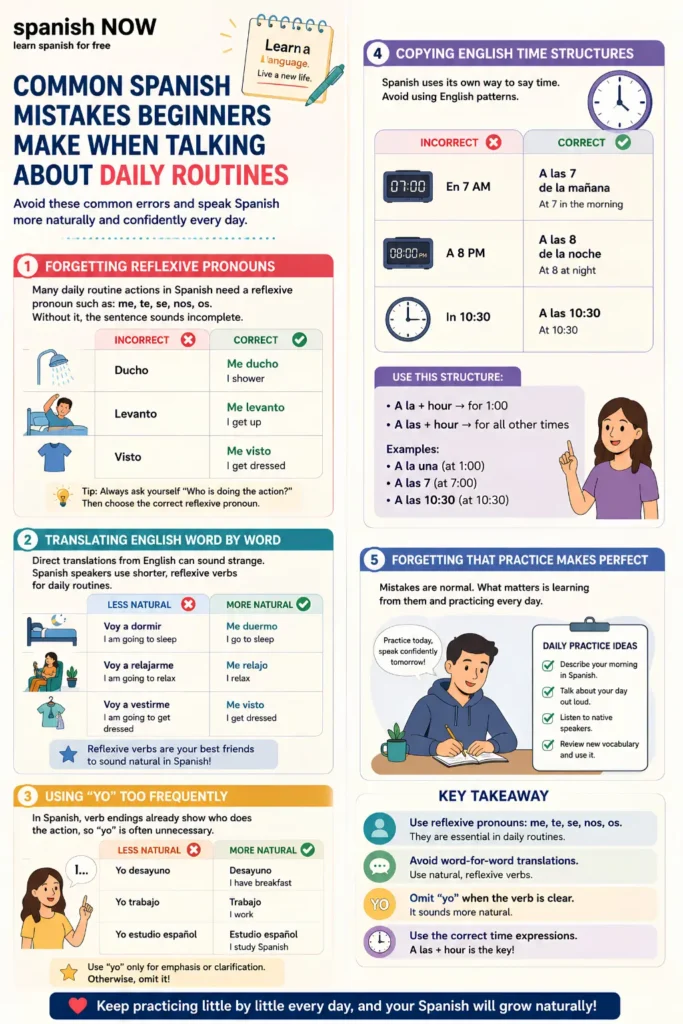
Do not worry if you make some of these mistakes at first. They are a normal part of learning Spanish, and recognizing them early will help your Spanish sound much more natural over time.
When English speakers start learning Spanish daily routines, they often make the same grammar mistakes again and again. This happens because Spanish sentence structures work differently from English.
The good news is that these mistakes are completely normal. Once you understand the patterns behind them, your Spanish will immediately sound more natural.
Below, you will learn some of the most common errors beginners make when describing their daily routines in Spanish, along with simple explanations and correct examples.
Mistake 1: Forgetting Reflexive Pronouns
One of the biggest challenges for English speakers is remembering reflexive pronouns.
In English, people usually say:
- “I shower”
- “I wake up”
- “I get dressed”
But in Spanish, these actions normally require reflexive pronouns such as:
- me
- te
- se
- nos
- os
Because of this difference, many beginners accidentally remove the pronoun.
Incorrect vs Correct Examples
| Incorrect Spanish | Correct Spanish |
|---|---|
| Ducho | Me ducho |
| Levanto | Me levanto |
| Visto | Me visto |
Without the reflexive pronoun, the sentence sounds incomplete or unnatural to native speakers.
Mistake 2: Translating English Word by Word
Many learners try to build Spanish sentences using English grammar patterns. This usually creates sentences that are understandable, but not natural.
A common example appears with sleep routines.
Less Natural: I sleep.
| English Translation Style | More Natural Spanish |
|---|---|
| Yo duermo | Me duermo |
Spanish speakers often prefer reflexive verbs when talking about everyday routines.
Another example: I relax.
| Less Natural | More Natural |
|---|---|
| Yo relajo | Me relajo |
| Yo visto | Me visto |
Shorter reflexive structures are much more common in daily conversation.
Mistake 3: Using “Yo” Too Frequently
In English, every sentence needs a subject:
- “I work”
- “I study”
- “I eat”
Spanish works differently because verb endings already show who performs the action.
For that reason, native speakers often omit the subject pronoun.
| Less Natural Spanish | More Natural Spanish |
|---|---|
| Yo desayuno | Desayuno |
| Yo trabajo | Trabajo |
| Yo estudio español | Estudio español |
Using “yo” is not grammatically wrong, but repeating it constantly can sound unnatural and repetitive.
Native speakers usually include “yo” only for emphasis or clarification.
Mistake 4: Copying English Time Structures
Another very common beginner mistake involves telling time. English speakers often try to translate directly from English sentence patterns.
| Incorrect | Correct |
|---|---|
| En 7 AM | A las 7 de la mañana |
| A 8 PM | A las 8 de la noche |
In Spanish, the normal structure is:
- a la + hour (for 1:00)
- a las + hour (for all other times)
Examples
| English | Spanish |
|---|---|
| At 1:00 | A la una |
| At 7:00 | A las 7 |
| At 10:30 | A las 10:30 |
This structure is essential when describing routines and schedules.
Why These Daily Routine Mistakes Matter
Daily routine conversations are some of the first real conversations beginners have in Spanish. Because of that, these grammar patterns appear constantly.
Learning:
- reflexive verbs,
- natural sentence structure,
- time expressions,
- and subject omission
will help your Spanish sound much smoother and more authentic.
Most importantly, do not worry about making mistakes at the beginning. These patterns become much easier with repetition and daily practice.
Practice Exercises: Spanish Daily Routines for Beginners
Now it’s time to practice your Spanish daily routine vocabulary and reflexive verbs. The following exercises will help you connect English phrases with their Spanish equivalents, complete sentences naturally, and improve your listening and reading comprehension skills.
Try to answer each activity without translating every single word. Focus on recognizing patterns, common routine expressions, and reflexive verbs like:
me despierto
me levanto
me ducho
me acuesto
These are some of the most common structures in everyday Spanish conversations.
Take your time, repeat the phrases aloud, and most importantly, enjoy the learning process.
Exercise 1: Match Daily Routine Steps with Spanish Phrases
Match the English activity with the correct Spanish expression.
Exercise 3: Listening Practice — Pablo’s Weekly Routine in Spanish
Use this listening activity to practice Spanish daily routine vocabulary in a real context. In this example, Pablo is a university student who describes his routine from Monday to Friday and explains what he usually does on weekends.
Try listening to the text first without translating every word. Focus on identifying familiar verbs and routine expressions like:
- me levanto
- desayuno
- estudio
- me acuesto
Then, listen again and see how much you understand.

Exercise 4: Reading Comprehension Questions About Pablo’s Routine
Complete each sentence with the correct Spanish reflexive verb. Practice Spanish daily routines and reflexive verbs with this beginner fill-in-the-blank activity.
Exercise 5: Reading Comprehension Exercise — Intermediate Beginner Level
Instructions: Reading Comprehension: Pablo’s Daily Routine. Read the text carefully and answer the following questions in Spanish.
Hola, me llamo Pablo y soy estudiante universitario. Estoy aquí porque te quiero contar un poco sobre mi rutina diaria.
De lunes a viernes me despierto bien temprano en la mañana…, a eso de las 6:30 de la mañana. Me levanto rápidamente y me ducho antes de desayunar.
Normalmente desayuno algo ligero como café, fruta y unas tostadas. Después, voy a la universidad, donde estudio ingeniería.
Por la tarde, hago la tarea en la biblioteca y luego trabajo en una cafetería. Cuando llego a casa, siempre ceno con mi familia y paso la tarde noche viendo videos en YouTube. Por lo general me acuesto a las 9 y 30 porque necesito descansar para las clases.
Los fines de semana mi rutina es algo diferente. Los sábados me despierto más tarde y salgo con mis amigos. A veces jugamos al fútbol o vamos al cine. Siempre trato de hacer algo divertido. Los domingos descanso en casa. Paso el día relajado, escuchando música y preparando mis cosas para la semana.
Ah, se me olvidó contarte que también estudio inglés todos los días. Eso es muy importante para mi porque quiero hablar más idiomas.
Final Thoughts: Practice Your Daily Routine in Spanish Every Day
Learning Spanish through daily routines is one of the most effective ways to build real vocabulary and improve your listening skills naturally. By practicing stories like Pablo’s routine, you start recognizing common reflexive verbs, time expressions, and everyday phrases that native speakers use constantly. The more you listen, read, and repeat these routines, the more confident you will feel speaking Spanish in real conversations.
Now it’s your turn. Try writing a few sentences about your own daily routine in Spanish using the vocabulary from this lesson. What time do you wake up? What do you usually do on weekends? Share your answers in the comments and keep practicing every day. Small daily habits can make a huge difference in your Spanish journey.
Frequently Asked Questions About Daily Routines in Spanish
To describe your daily routine in Spanish, you usually use reflexive verbs and simple present tense sentences. Common expressions include:
Me despierto a las 7.
Me ducho por la mañana.
Desayuno café y tostadas.
Spanish daily routines often focus on actions that happen every day, such as waking up, studying, working, eating, and going to sleep.
Reflexive verbs are verbs that describe actions a person does to themselves. These verbs are extremely common when talking about routines and personal habits.
Examples:
Me visto → I get dressed
Me acuesto → I go to bed
Reflexive verbs usually use pronouns like:
me
te
se
nos
os
Learning reflexive verbs is essential for speaking naturally about everyday activities in Spanish.
Daily routines are one of the best topics for beginner Spanish learners because the vocabulary is practical and repetitive. Since these actions happen every day, students can remember the phrases more easily and start using them in real conversations quickly.
Practicing daily routines also helps learners improve:
reflexive verbs,
time expressions,
sentence structure,
and everyday vocabulary.
Some of the most common Spanish daily routine phrases include:
Me despierto → I wake up
Me ducho → I take a shower
Voy al trabajo → I go to work
Hago la tarea → I do homework
Me relajo → I relax
Me acuesto → I go to bed
These expressions are used in beginner Spanish conversations.
“I wake up” in Spanish is: Me despierto
Example:Me despierto a las 6 de la mañana.